AI-Driven Infrastructure: How Artificial Intelligence Is Rewriting Web Hosting Architecture
Discover how artificial intelligence is transforming web hosting. From predictive resource scaling and automated malware patching to AI-driven DevOps optimization.
 John
John
AI-Driven Infrastructure: How Artificial Intelligence Is Rewriting Web Hosting Architecture
For decades, the web hosting industry competed strictly on raw hardware specs: solid-state drive speeds, physical RAM allocations, and data center locations. However, as web applications grow increasingly dynamic and security threats become automated, static server management is hitting a wall.
The traditional system administrator paradigm is shifting toward autonomous, AI-driven server management.
Modern hosting providers are no longer just renting out passive space in a rack. They are deploying machine learning layers directly into the hypervisor and control panels. This integration turns standard hosting environments into self-optimizing, self-healing digital ecosystems.
For developers and site owners, this architectural shift changes how websites scale, defend against attacks, and utilize processing power.
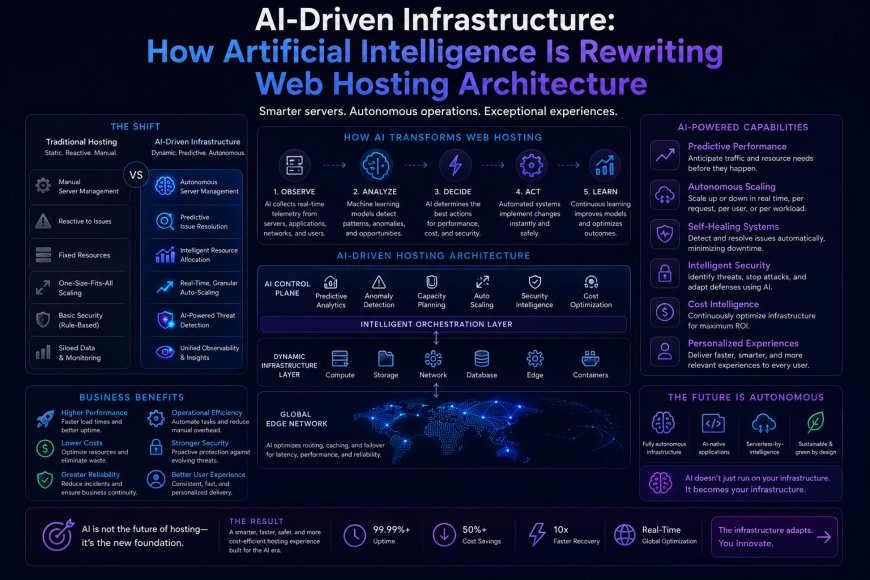
The Structural Shift: Traditional Hosting vs AI-Native Infrastructure
When artificial intelligence moves from the application level down to the server core, standard performance metrics change completely.
| Infrastructure Layer | Traditional Web Hosting | AI-Driven Web Hosting |
| Resource Allocation | Static limits (Triggers 503 errors during traffic spikes) | Predictive scaling (Allocates RAM ahead of anticipated traffic surges) |
| Security & Firewalls | Reactive signature matching (Blocks known bad files) | Behavioral anomaly detection (Patches zero-day exploits in real time) |
| Database Tuning | Manual index adjustments and database cleanup | Automated, continuous MySQL script query optimization |
| Error Diagnosis | Manual parsing of server error logs | Predictive diagnostics (Fixes server memory leaks autonomously) |
| DevOps Migration | Manual database exports and asset staging links | Smart site deployment and custom architecture provisioning |
Three Core Breakthroughs in AI Hosting Technology
1. Predictive Resource Scaling and Elasticity
Traditional cloud scaling is reactive: when CPU usage hits 90%, the system boots up another node. AI-native hosting models use predictive time-series analysis. By evaluating historic traffic curves, global internet speed trends, and seasonal traffic cycles, the server infrastructure anticipates load surges before they occur.
The hypervisor quietly scales processing capacity up or down in seconds. This eliminates the latency spike associated with launching standard backup virtual instances mid-surge.
2. Autonomous Behavioral Security and Zero-Day Defense
Standard server firewalls are rule-based; they cross-reference incoming web requests against a database of known signatures. If a hacker deploys an entirely new zero-day exploit variation targeting a platform like WordPress, standard firewalls miss it.
AI-driven hosting security environments monitor system telemetry and user behavior anomalies instead. If an automated script executes commands inside a file directory in a pattern that deviates from standard human user paths, the AI containerizes and neutralizes the thread instantly, patching the server vulnerability before an official security update is even compiled.
3. Integrated AI DevOps and SysAdmin Automation
The hosting control panel is evolving into an autonomous engineering assistant. Instead of manually configuring complex server files, setting up custom Cron jobs, or troubleshooting cryptic database connection dropouts, developers interact directly with infrastructure models inside their control panels.
[System Error Code] ──> [AI Agent Diagnosis] ──> [Automated Sandbox Patch] ──> [Live Deployment]
These models parse server errors, automatically spin up matching staging sandbox environments to safely test code patches, and deploy optimized server configurations tailored specifically to the code structure of your active database.
Strategic Infrastructure Verdict
When selecting a web hosting infrastructure vendor today, evaluating standard hardware configurations is no longer enough. The defining competitive edge is the software intelligence controlling that hardware.
Prioritize hosting platforms that deploy active machine learning layers within their server infrastructure to handle automated thread isolation, real-time query optimization, and predictive performance adjustments. True operational reliability means moving away from manual system monitoring and adopting a server environment that optimizes itself.