How to Build a Minimalist Productivity Stack: Reducing Software Bloat
Is software bloat destroying your team's efficiency? Learn how to build a minimalist productivity stack by consolidating databases, tasks, and communication.
 John
John
How to Build a Minimalist Productivity Stack: Reducing Software Bloat
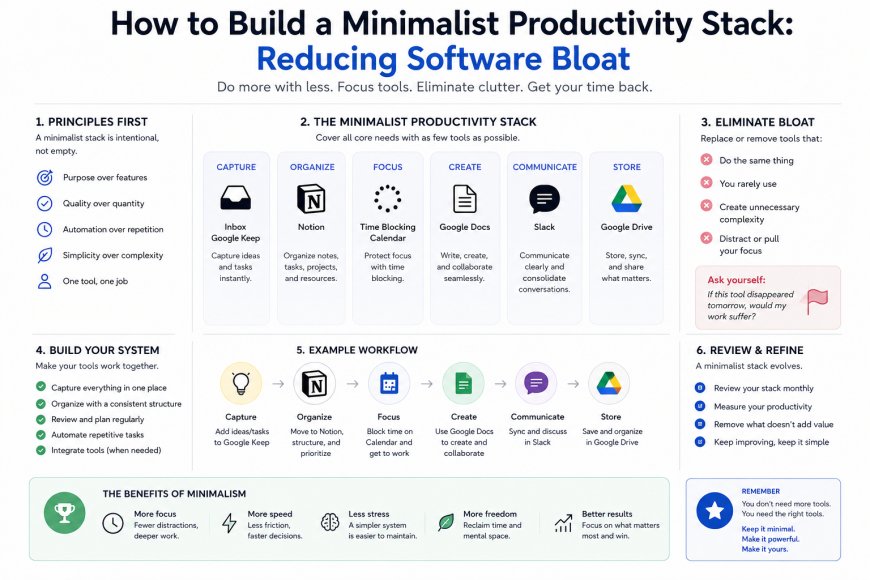
The modern enterprise workspace faces a critical operational challenge: software bloat. As platforms specialize, companies frequently deploy a chaotic web of applications—using one tool for task tracking, another for documentation, a third for internal messaging, and separate niche software for goal setting.
While each application promises to maximize efficiency, the aggregate effect introduces severe liabilities. Forcing teams to constantly jump between interfaces introduces heavy cognitive switching costs, fragments institutional data, and creates massive administrative overhead just to keep distinct systems updated.
True organizational throughput is achieved not by multiplying platforms, but by consolidating workflows into a highly integrated, minimalist software core.
The Cost of Fragmentation: Proliferation vs Consolidation
When evaluating a corporate software stack, management must calculate the hidden friction costs of maintaining disconnected platforms versus the benefits of unified environments.
| Workspace Operation | Fragmented Multi-Tool Approach | Consolidated Minimalist Stack |
| Information Discovery | Searching across multiple siloed apps | Universal search inside a central wiki database |
| Context Switching | Constant tab swapping (High cognitive friction) | Working within a single unified workspace interface |
| API Maintenance | Complex multi-point integrations required | Native internal links and standardized database relations |
| Licensing Overhead | High cumulative subscription fees per seat | Consolidated invoicing and unified seat provisioning |
| Data Integrity | High risk of duplicate or outdated files | Single source of truth across all operational layers |
Three Steps to Clean Up Your Operational Stack
1. Enforcing a Single Source of Truth for Documentation
A primary source of confusion in fast-growing teams is tracking down the latest version of a system operating procedure (SOP) or project brief. Organizations must mandate a single platform—such as Notion or Confluence—as the absolute repository for company knowledge. If an operational document does not exist inside the central workspace directory, it technically does not exist within the organization.
2. Collapsing Tasks and Docs Into a Unified Layer
Historically, companies kept project conversations inside task managers and project documentation inside word processors. Modern productivity frameworks eliminate this division. By utilizing databases where every single task entry is also a complete, fully editable text canvas, contextual notes, code snippets, and deployment checklists stay pinned directly inside the asset ticket itself.
3. Migrating to Asynchronous Documentation Over Chat Log Dependencies
Relying on chat histories to preserve company decisions is an structural error. Group chat platforms are designed for transient, real-time coordination, not for permanent archival. When a critical operational decision is finalized in a discussion thread, the core conclusion must be extracted instantly and logged into the central wiki database before the conversation disappears up the active feed.
Strategic Implementation Verdict
Building a minimalist productivity stack requires making difficult consolidation decisions. It means choosing comprehensive, flexible tools that perform multiple functions well over deploying ten separate hyper-specialized applications.
Audit your current operational toolset today. Identify overlapping software features, eliminate platforms that do not feature native integrations, and reduce your ecosystem down to a tight, high-performance core. The ultimate goal of productivity design is to clear away digital noise so your engineers and creators can focus entirely on deep execution.