The Best AI Web Solutions for Developers and Businesses in 2026
Discover the best AI web solutions in 2026. Learn how to integrate generative UI, vector databases, and semantic search to build intelligent, high-converting platforms.
 John
John
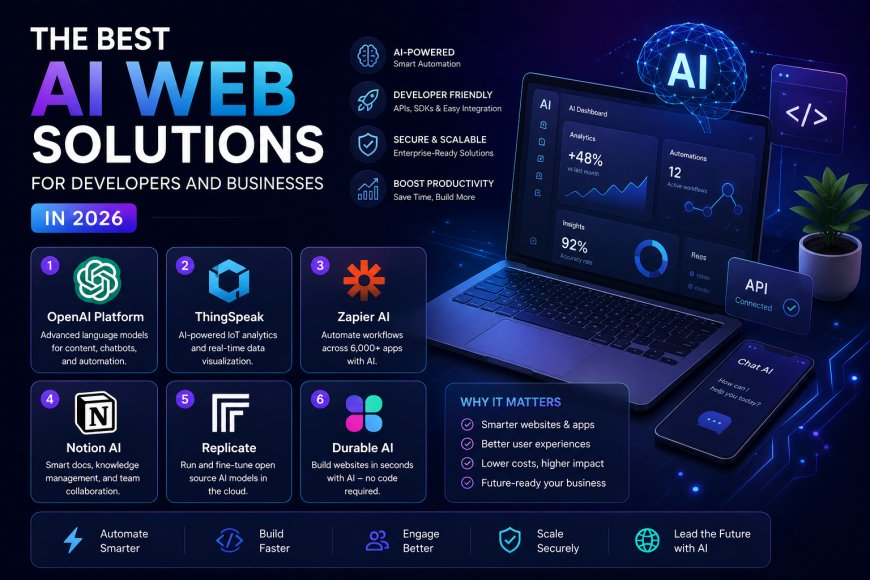
The Best AI Web Solutions for Developers and Businesses in 2026
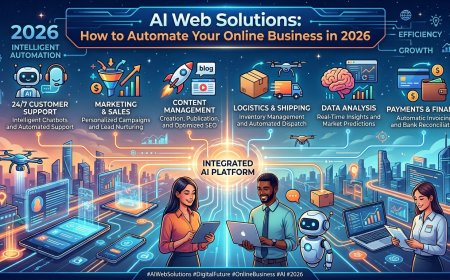
Building a website is no longer just about writing clean HTML, CSS, and JavaScript. In 2026, the internet is driven by dynamic, personalized, and automated experiences. AI Web Solutions have evolved from simple chatbots to complex engines capable of generating code, optimizing user interfaces in real time, and transforming data into functional applications.
If you want your web platform to stay competitive, you need to integrate intelligence into your stack. This guide breaks down the absolute best AI web solutions available this year, backed by modern web architecture and data science, to supercharge your digital presence.
The Core Problem: The Shift from Static Webs to Intelligent Platforms
Traditional websites are static; they show the same content to every user and require manual updates for every new feature. In a fast-paced digital economy, this approach creates massive bottlenecks for developers and poor conversion rates for businesses.
The Personalization Paradox: Data shows that modern web users are 80% more likely to convert or engage with a platform if the user experience (UX) dynamically adapts to their specific behavior and search intent in real time.
Integrating AI solutions directly into your web infrastructure allows you to automate software development lifecycles, deliver hyper-personalized user experiences, and scale operations without multiplying your engineering costs.
The Top AI Web Solutions for 2026
Here is our curated selection of AI web technologies and platforms that offer the highest return on investment (ROI) for modern web development and digital strategy.
1. Vercel v0: Next-Gen Generative UI
Vercel's v0 has completely revolutionized front-end development by translating natural language into production-ready UI components using modern frameworks like React, Tailwind CSS, and Shadcn UI.
-
The Foundation: Traditional UI prototyping takes days of back-and-forth between design and development teams. Generative UI bridges this gap instantly using advanced LLMs (Large Language Models) trained on premium code architectures.
-
Best Feature: You can describe an interface in plain English (e.g., "Build a dark-mode dashboard for an e-commerce checkout"), and it instantly generates semantic, accessible, and responsive code.
-
Ideal For: Front-end developers, UI/UX engineers, and rapid prototyping.
2. OpenAI API & Assistants: Tailored Web Intelligence
For adding core intelligence—such as advanced search, automated content moderation, or semantic data processing—directly into your web application, the OpenAI API remains the gold standard for web developers.
-
The Foundation: Instead of building complex machine learning models from scratch, web platforms can leverage billions of parameters of pre-trained data through secure, scalable REST APIs.
-
Best Feature: The Assistants API manages conversation state, file indexing, and tool execution automatically, making it easy to embed intelligent agents within any web dashboard.
-
Ideal For: Full-stack developers building SaaS platforms, custom internal tools, and intelligent databases.
3. Supabase AI & Vector Databases: Semantic Web Search
If your website relies heavily on content, documentation, or large catalogs, traditional keyword matching is no longer enough. Supabase (with pgvector) allows web apps to store and query data based on human meaning.
-
The Foundation: It utilizes Vector Embeddings, transforming text into mathematical coordinates. When a user searches your site, the AI understands what they mean, not just the exact words they typed.
-
Best Feature: Seamless integration with PostgreSQL, allowing you to combine secure relational user data with powerful vector-based semantic search.
-
Ideal For: E-commerce search optimization, massive knowledge bases, and content-heavy platforms.
4. Algolia AI Search & Discovery: Hyper-Personalized UX
Algolia has successfully infused AI into the core of web discovery. It goes beyond simple search by predicting what a user wants to see next based on their real-time browsing behavior.
-
The Foundation: Driven by machine learning algorithms that analyze clickstream data, query intent, and seasonal trends to re-rank web content dynamically.
-
Best Feature: Natural Language Processing (NLP) that accurately handles typos, synonyms, and conversational queries across multiple languages instantly.
-
Ideal For: Enterprise e-commerce platforms, marketplaces, and high-traffic media sites.
???? Quick Comparison: Which AI Solution Does Your Web App Need?
| Solution / Tool | Primary Purpose | Best For | Implementation Complexity |
| Vercel v0 | Frontend Generation & UI | Creating modern React/Tailwind layouts | Low |
| OpenAI API | Custom AI Logic & Agents | Building proprietary SaaS features | High |
| Supabase AI | Semantic Storage & Search | Smarter data querying and backend scaling | Medium |
| Algolia AI | Real-time Search & Discovery | Maximizing e-commerce conversion rates | Medium |
How to Responsibly Architect an AI-Powered Web App
When building AI web solutions, it is easy to overcomplicate your infrastructure. To build a robust, secure, and fast platform, keep these three architectural pillars in mind:
-
Prioritize Edge Computing: Run your AI UI logic and API routing on edge networks (like Vercel or Cloudflare Workers) to minimize latency and ensure your website loads in milliseconds.
-
Protect User Privacy: Never send sensitive user data or unencrypted private credentials to public AI models. Utilize secure API gateways and strict data-processing agreements.
-
Establish Fail-Safes: AI models can hallucinate or fail. Always design your web application with graceful fallbacks—if an AI feature times out, the website should seamlessly revert to a standard functional state.
Conclusion: Embrace AI-Driven Web Architecture
The future of the web belongs to platforms that can think, adapt, and respond instantly to human input. By incorporating tools like generative UI, vector databases, and semantic search into your stack, you aren't just automating your workflow—you are building a future-proof digital product.
???? Over to you: Have you integrated any AI solutions into your current web projects? What is the biggest hurdle you've faced with AI implementation? Let's discuss in the comments below!