
Goodbye useMemo: How the React Compiler Changes Frontend Dev Forever
The React Compiler has officially eliminated manual memoization. Learn how automated optimization impacts your React and Next.js applications this year.
 John
John
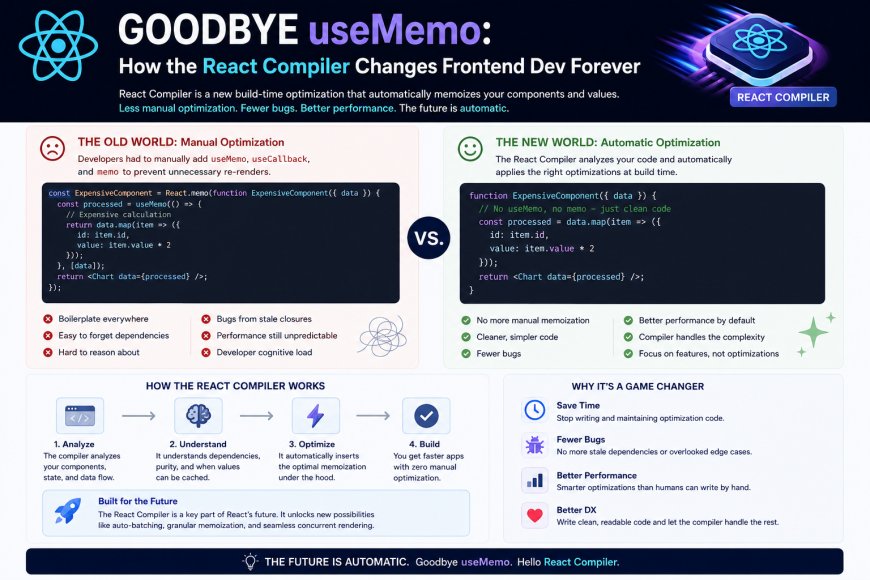
Goodbye useMemo: How the React Compiler Changes Frontend Dev Forever
For years, optimizing a high-performance React application felt like an explicit game of memory management. Frontend engineers spent countless hours tracking unnecessary component re-renders, wrapping event handlers in useCallback, and caching heavy computations inside useMemo.
If you missed a single dependency array, your application’s performance tanked. If you over-optimized, your codebase became a unreadable maze of boilerplate code.
That era of manual tuning is officially dead. The widespread adoption of the React Compiler has transformed how we reason about frontend performance. By shifting the optimization burden from the developer’s brain to the build pipeline, React has entered its automated, compiler-driven era.
If you are still writing manual memoization hooks in your projects, you are working with a legacy mindset. This guide explains how the React Compiler works under the hood and how it changes frontend development.
The Core Problem: The Mental Tax of Manual Optimization
In standard React, every time a component's state changes, the entire component function re-executes. If that component renders a massive data table or processes an intensive filtering algorithm, the browser struggles to keep up, leading to dropped frames and sluggish user interactions.
To prevent this, React gave us three primary primitives: useMemo, useCallback, and React.memo. However, this manual approach introduced three major issues:
-
High Cognitive Overhead: Developers had to constantly analyze which objects and functions actually needed caching, breaking their mental focus during feature development.
-
Brittle Dependency Arrays: A slight mistake or an omitted variable inside a dependency array led to stale closures, caching bugs, and hard-to-trace UI anomalies.
-
Cluttered Codebases: Components became bloated with defensive optimization wrappers, making refactoring and code reviews significantly more complicated.
How the React Compiler Works: True Auto-Memoization
The React Compiler is a build-time tool that automatically optimizes your code. Instead of forcing the developer to declare what to cache, the compiler parses your standard JavaScript and React rules, deeply understands the data flow, and injects reactivity optimizations automatically during compilation.
The Rule of Least Surprise: You simply write standard, idiomatic React code. The compiler guarantees that your UI re-renders only when the strictly underlying data changes.
The compiler safely automates performance injection through three structural phases:
-
Strict Rules of React Enforcement: The compiler uses static analysis to ensure your components are pure functions and that state mutations follow strict React guidelines.
-
Component and Hook Detection: It scans your codebase to identify standard React components and custom hooks, isolating them from plain utility functions.
-
Granular Memoization Injection: It splits your JSX nodes, hook outputs, and complex objects into hyper-specific dependency blocks, caching them at a byte-code level before delivering the bundle to the browser.
Quick Contrast: Manual vs. Compiler-Driven React
| Development Aspect | Manual React (Legacy) | Compiler-Driven React (Modern) |
| Caching Mechanism | Explicit useMemo and useCallback |
Automated build-time dependency injection |
| Code Readability | Low (Bloated with defensive wrappers) | High (Clean, standard JavaScript syntax) |
| Human Error Risk | High (Stale dependency arrays) | Zero (Handled entirely by the compiler) |
| Component Performance | Optimized selectively by the developer | Optimized globally and uniformly by default |
| Interaction to Next Paint (INP) | Highly variable based on dev skill | Consistently low due to efficient rendering |
What Should You Do with Your Legacy Codebase?
If you are managing a mature React or Next.js application, the introduction of automated compilation requires a pragmatic migration strategy:
-
Do Not Delete Old Hooks Immediately: The React Compiler is fully backward compatible. If your codebase is filled with existing
useMemoanduseCallbackstatements, the compiler will safely bypass or optimize them without breaking your app. -
Run Strict Linters First: The compiler assumes your code adheres to the basic laws of React (such as not mutating props or state directly during rendering). Run the official React ESLint plugins to catch structural bad practices before turning the compiler on.
-
Phase Out Memoization in New Features: Train your development team to stop writing defensive caching hooks entirely for new components. Write clean, descriptive code, and let your build setup handle the performance layer.
Conclusion: Focus on Experience, Not Micro-Optimizations
The ultimate victory of the React Compiler isn't just faster rendering speeds; it is the liberation of developer time. By removing the mechanical complexity of UI optimization, engineers can finally step away from micro-tuning and focus entirely on what truly matters: design system consistency, accessible user flows, and exceptional product architecture.
What is your team’s transition plan? Have you already integrated the React Compiler into your build pipelines, or are you still manually maintaining your dependency arrays? Let us know your thoughts in the comments below!