Edge AI vs. Cloud AI: Where Should You Run Your Web Models?
Should you deploy your AI models on the cloud or at the edge? Discover the technical differences, costs, and latency impacts for modern web applications.
 John
John
Edge AI vs. Cloud AI: Where Should You Run Your Web Models?
In the early days of the artificial intelligence boom, the architectural choice was simple: you sent a user's request via an API to a massive cluster of GPUs hosted by a cloud provider, waited for the response, and piped it back to the browser.
However, as web applications become deeply hyper-intelligent, relying solely on centralized cloud infrastructure is exposing massive critical bottlenecks. High latency, skyrocketing API token costs, and growing user data privacy concerns are forcing software architects to re-evaluate their deployment strategies.
The big question today is no longer which model to use, but where to run it. Should you keep your intelligence in the cloud, or shift it to the edge? This guide breaks down both paradigms to help you design a fast, secure, and cost-effective AI web infrastructure.
The Core Problem: The Bottlenecks of Centralized Cloud AI
Centralized Cloud AI (sending data to external servers like AWS, Google Cloud, or OpenAI) provides immense raw computing power. It allows you to run massive frontier models with hundreds of billions of parameters.
However, for real-time web experiences, this approach introduces three severe challenges:
-
Network Latency: A round-trip request from a user’s browser to a remote cloud datacenter and back can easily take several seconds, killing the fluid user experience (UX).
-
Unsustainable Costs: Paying per million tokens scales exponentially. If your web app scales to millions of active users, cloud infrastructure bills can completely destroy your business margins.
-
Data Sovereignty: Moving sensitive user metrics, financial logs, or personal records to external third-party cloud servers triggers massive compliance risks (such as GDPR or local privacy regulations).
The Breakdown: Understanding the Paradigms
To make an informed architectural decision, we must understand exactly how these two infrastructures process intelligence.
1. Cloud AI: Massive Computing Power
Cloud AI relies on industrial-scale data centers. When a feature requires deep reasoning, multi-step logical planning, or heavy data synthesis, the cloud is the only environment capable of handling the workload.
-
The Foundation: Models run on high-performance enterprise GPU clusters. The web application acts merely as a thin client that sends inputs and renders outputs.
-
Best Feature: Access to state-of-the-art reasoning models without worrying about client-side hardware limitations.
-
Ideal For: Complex data analysis, generating high-resolution media, and massive background processing tasks.
2. Edge AI: Zero Latency & Complete Privacy
Edge AI shifts the computation away from centralized data centers. It executes models either on edge networks (like globally distributed serverless functions) or directly on-device inside the user's web browser using technologies like WebAssembly (Wasm) and WebGPU.
-
The Foundation: Utilizing highly optimized, smaller open-source models (such as Llama 3.1 8B or Phi-3) that can run efficiently on consumer-grade hardware or localized edge nodes.
-
Best Feature: Instantaneous execution. Because the data doesn't have to travel across the globe to a central hub, latency drops to near zero.
-
Ideal For: Real-time text autocomplete, client-side data filtering, offline-first web apps, and sensitive user privacy features.
Quick Comparison: Cloud Architecture vs. Edge Architecture
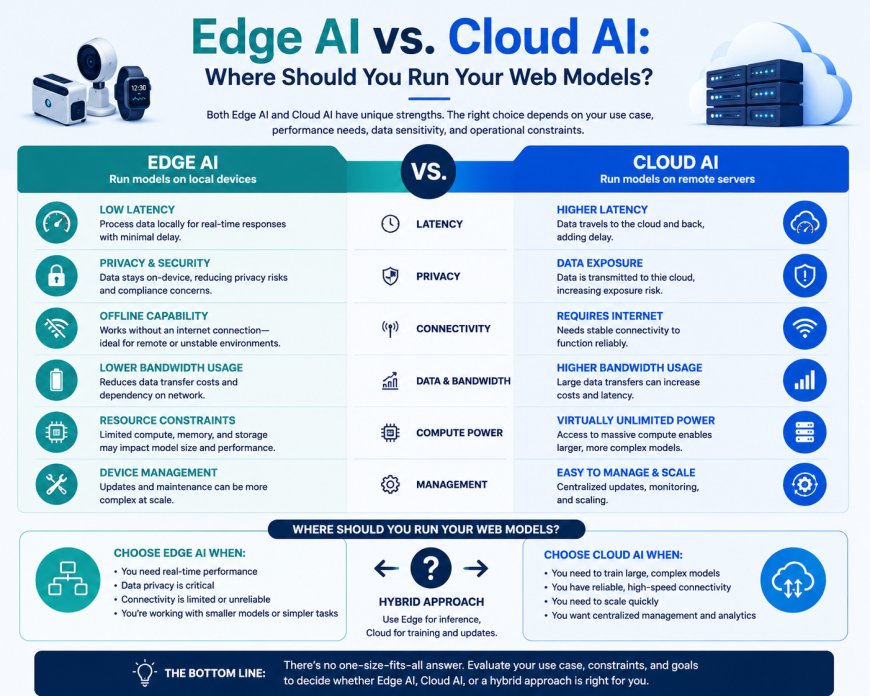
| Evaluation Metric | Cloud AI Architecture | Edge AI Architecture |
| Model Capability | State-of-the-art / Infinite complexity | Small to Medium / Domain-specific |
| Latency | Medium to High (Network dependent) | Ultra-low (Milliseconds) |
| Infrastructure Cost | High (Per-token or GPU uptime billing) | Extremely Low (Leverages client/edge compute) |
| Data Privacy | Requires explicit data transit and encryption | High (Data can stay completely on the local device) |
| Offline Support | Impossible | Fully functional offline |
The Modern Solution: Implementing a Hybrid AI Stack
You do not have to choose strictly one or the other. The most sophisticated web platforms use a Hybrid AI Architecture to balance cost, speed, and intelligence perfectly.
Here is how to design a hybrid routing logic inside your web application:
-
The Edge Layer (First Line of Defense): Use local, on-device models or edge workers to handle instantaneous user interactions. For example, use Edge AI for real-time form validation, input formatting, markdown parsing, or basic search categorization.
-
The Cloud Layer (Escalation Path): If the user triggers a complex request that requires deep semantic analysis or cross-referencing massive relational databases, gracefully escalate that specific task to your heavy cloud infrastructure.
By routing simple tasks to the edge and reserving the cloud only for complex calculations, you can reduce your infrastructure overhead by up to 60% to 80% while simultaneously speeding up your web interface.
Conclusion: Designing for the Next Web
The web is moving rapidly toward decentralized intelligence. Running every single AI interaction through a heavy, distant cloud server is an architectural anti-pattern. By embracing edge capabilities and strategically combining them with cloud power, you can build web platforms that are incredibly fast, completely secure, and financially sustainable.
What is your deployment strategy? Are you currently paying heavy API bills to cloud providers, or have you started experimenting with WebGPU and local browser-based models? Let us know in the comments below!