What is Model Context Protocol (MCP)? The New Architecture for AI Agents
What is Model Context Protocol (MCP)? Learn how this open standard architecture securely connects AI models and agents to databases, APIs, and local development tools.
 John Toledo
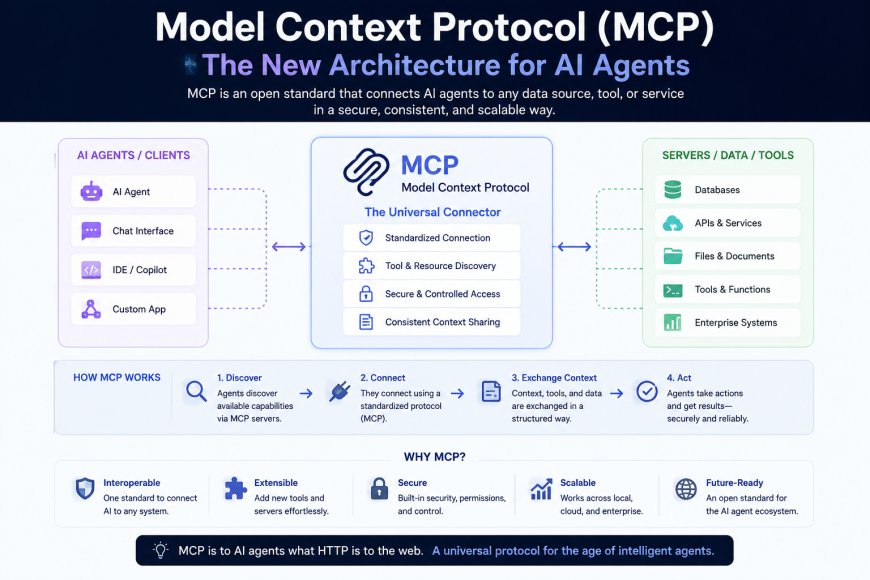
What is Model Context Protocol (MCP)? The New Architecture for AI Agents
Until recently, connecting Large Language Models (LLMs) to real-world data sources was a chaotic, fragmented process. Every developer had to write custom, ad-hoc integration pipelines, build proprietary API wrappers, and constantly tweak prompt formatting just to allow an AI tool to read a local file or query a secure corporate database.
That fragmentation is finally over. Model Context Protocol (MCP) has emerged as the definitive open standard for AI data integration. It establishes a secure, unified architectural blueprint that allows AI models, development platforms, and autonomous agents to communicate seamlessly with any data source.
If you are building AI-native applications or designing enterprise software systems, understanding MCP is no longer optional—it is the baseline for modern backend engineering.
The Core Problem: The Isolation of Large Language Models
By design, LLMs are fundamentally isolated. They operate inside closed environments, limited strictly to the static training data they were built on. To make them useful in production, engineers rely on Retrieval-Augmented Generation (RAG) or dynamic API calling.
However, traditional integration patterns suffer from three fatal flaws:
-
Security Vulnerabilities: Giving an external AI agent raw database access or system credentials creates massive prompt injection and data exfiltration vectors.
-
Brittle Architectures: If a backend API schema shifts by a single key, the LLM’s tool-calling logic frequently breaks, leading to silent application failures.
-
Redundant Engineering: Developers waste hundreds of hours rewriting identical connection logic for Slack, GitHub, PostgreSQL, and Jira across every new AI project.
How MCP Works: A Client-Server Architecture for Context
Model Context Protocol solves isolation by introducing a clean, decoupled Client-Server-Data pattern, heavily inspired by how the Language Server Protocol (LSP) standardized code syntax highlighting across different code editors years ago.
Instead of forcing the AI model to learn how to interact with dozens of unique APIs, the architecture is split into three highly specialized components:
-
The MCP Host: The application or interface that the developer interacts with (such as an advanced IDE like Cursor, or a developer platform like Claude Desktop). The host acts as the gatekeeper.
-
The MCP Client: A lightweight protocol layer running inside the host application that initiates secure sessions, negotiates capabilities, and passes contextual data safely to the LLM.
-
The MCP Server: A highly modular, independent microservice that sits directly on top of a specific data source (e.g., a Postgres database, a secure file system, or a Linear workspace). The server securely exposes resources, prompts, and tools through a standardized JSON-RPC API.
Quick Overview: The Three Core Building Blocks of MCP
Every MCP server exposes data and actions through three predictable, secure primitives:
| Primitive | Technical Function | Real-World Developer Example |
| Resources | Safe, read-only data streams that provide raw context to the model. | Passing database schemas, localized logs, or raw markdown documentation files. |
| Prompts | Reusable, pre-structured template shortcuts that guide model behavior. | A built-in server prompt like "Review this recent git commit for security bugs." |
| Tools | Actionable executable routines that allow the AI to actively modify states. | Compiling a piece of code, writing a file to disk, or triggering a production deployment. |
Why MCP is a Massive SEO and Industry Trend
If you look closely at current software development trends, tech teams are shifting aggressively from building simple chatbots to orchestrating Multi-Agent Systems.
The reason MCP search volume is growing exponentially is simple: it eliminates the integration bottleneck. Instead of writing a custom integration from scratch, an engineer can download a pre-built, open-source MCP server for GitHub, Docker, or Postgres, plug it in, and give their AI assistant immediate, secure superpowers in under five minutes.
Furthermore, because it isolates data access behind the MCP server layer, enterprise security teams can precisely audit what files an AI agent can read and what commands it is allowed to execute, removing the primary corporate blocker for AI adoption.
Conclusion: The New Layer of the Modern Tech Stack
Model Context Protocol is rapidly becoming the universal socket for artificial intelligence. By decoupling data access from model capabilities, it allows backend developers to build secure, highly modular data sources that any present or future LLM can immediately understand.
What do you think? Are you planning to implement MCP servers in your current architecture, or are you still relying on custom webhooks? Let's talk about it in the comments below!