Understanding Headless CMS Architecture: The Modern Content Guide
Are monolithic platforms slowing down your web performance? Discover Headless CMS architecture. Learn how to decouple content management from your frontend layer.
 John Toledo
Understanding Headless CMS Architecture: The Modern Content Guide
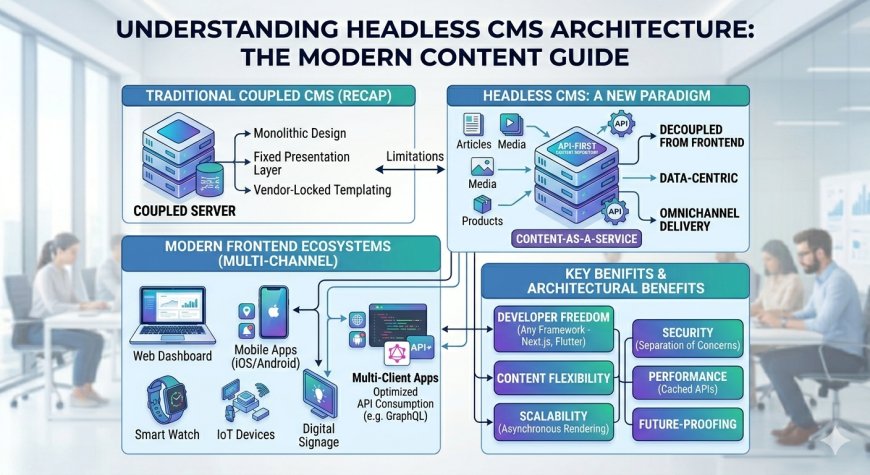
For years, the standard approach to launching a content-driven website relied on monolithic content management systems (CMS). These traditional platforms bound your database, your administrative content editor, and your visual frontend presentation layer into a single, tightly coupled codebase.
While this centralized approach worked well for simple desktop websites, it introduces massive roadblocks in the modern multi-device ecosystem. Forcing a heavy legacy framework to generate your HTML pages on the server makes your platform slow, vulnerable to security compromises, and incredibly difficult to scale across separate mobile apps or modern JavaScript frontend frameworks.
Headless CMS architecture completely resolves this limitation. By detaching the backend content repository from the frontend presentation layer, this modern infrastructure pattern changes how businesses manage and distribute digital experiences.
The Core Problem: The Monolithic Presentation Lock-In
Traditional monolithic content management systems operate with a rigid coupling between how content is stored and how it is rendered in the user's browser.
The Architectural Vulnerability: Because the presentation templates are tied directly to the backend database structures, making a major design update or shifting to a new frontend technology forces you to rebuild your entire system from scratch. You cannot change your visual layout without risking database corruption or breaking backend plug-ins.
Furthermore, monolithic engines scale poorly under heavy traffic spikes. Because the server must process complex database queries and compile full HTML templates for every single visitor request, server memory and CPU utilization saturate quickly, leading to high latency and unexpected downtime.
The Architecture: The API-First Topology
A Headless CMS architecture strips away the "head" (the frontend presentation layer) entirely. The platform functions strictly as an organized data repository that exposes content to the cloud using standardized API endpoints.
A modern decoupled content infrastructure manages operations through three independent layers:
-
The Content Repository: A secure backend interface where administrators, marketing teams, and editors write and organize structured content, independent of how it will look visually.
-
The API Delivery Gateway: The communication system that exposes the stored content as raw, structured data payloads using high-performance REST or GraphQL endpoints.
-
The Autonomous Frontend: Any independent application—whether built with Next.js, Astro, iOS native code, or electronic screens—that fetches the raw API data and styles it specifically for the target device.
Quick Contrast: Traditional Monolithic CMS vs. Headless CMS
| Performance Metric | Traditional Monolithic CMS Stack | Headless API-First CMS Stack |
| Frontend Flexibility | Locked into specific platform layout templates | Complete design freedom using any web framework |
| Global Load Speeds | Slow (Heavy server-side generation per request) | Fast (Data fits perfectly into static edge CDNs) |
| System Security Surface | High (Exposed database administration pathways) | Low (Backend sits completely hidden behind secure APIs) |
| Omnichannel Delivery | Restricted to a single desktop/mobile website view | Distributed simultaneously to web, apps, and devices |
| Infrastructure Scalability | Expensive (Requires scaling heavy application servers) | Efficient (Requires scaling only thin, lightweight API layers) |
How to Migrate to a Decoupled Headless Infrastructure
Transitioning your enterprise content strategy from a legacy monolith into a headless architecture requires a clean separation of your data contracts and rendering pipelines.
A Critical Operational Reality: Shifting to a headless architecture requires a clear division of operational responsibilities within your organization. Because the visual layout is completely separated from the content manager, marketing teams lose the ability to inject custom, arbitrary script files or alter raw site styles directly inside the text editor. Your design and development teams must establish a rigorous component system to ensure layout consistency across all digital channels while content editors focus purely on producing high-quality copy.