How to Stop Server Crashes: Decoupling Node.js Applications with Redis
Stop scaling expensive server hardware. Learn how to prevent backend crashes and handle high traffic spikes by decoupling your Node.js apps using Redis queues.
 John
John
How to Stop Server Crashes: Decoupling Node.js Applications with Redis
The day arrives when your application starts receiving real-world production traffic. Users flood in, your server begins throwing catastrophic 504 Gateway Timeout errors, and the engineering team's immediate reaction is almost always identical: "We need to upscale our cloud instances or throw more virtual CPUs at the database."
This is a critical architectural anti-pattern. Scaling vertically is merely an expensive band-aid over a fundamentally flawed structural design.
The silent killer of modern backend performance isn't a lack of computing hardware; it is synchronous coupling. If your primary HTTP thread has to wait for a heavy report to compile, a PDF to generate, and an email array to dispatch before returning a standard 200 OK response, you are bleeding connection pools.
To solve concurrency bottlenecks once and for all, you must transition to an asynchronous Event-Driven Architecture utilizing message queues.
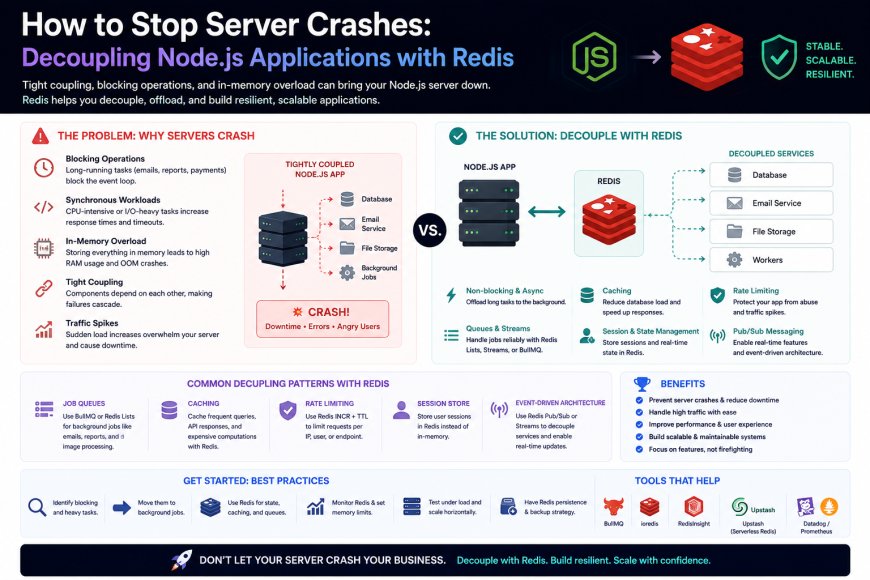
The Infrastructure Shift: Synchronous vs. Decoupled Processing
When you decouple your application logic, your platform's operational flow transitions from a brittle, blocked chain of actions into a resilient, fluid, and highly elastic pipeline.
The Core Components of an Asynchronous Queue
To eliminate server-level resource starvation, you must decouple your monolithic logic into three specialized micro-layers:
1. The Producer (The Fast Gatekeeper)
The Producer is your public-facing API web server. Its unique responsibility is to intercept incoming user requests, convert the incoming payload into a lightweight, stringified JSON message, push it into a data pipeline, and immediately return a 202 Accepted status back to the client.
-
The Benefit: Because the API thread does not execute the actual business logic, request-response lifecycles drop to under 50 milliseconds, keeping your HTTP threads permanently available.
2. The Broker (The Resilient Buffer)
The Broker sits safely between your public gateway and your heavy application databases. By utilizing highly optimized database structures like Redis lists (LPUSH / BRPOP), it holds incoming state payloads persistently in-memory.
-
The Benefit: If your app experiences an aggressive traffic spike, the broker buffers the load. Your main relational databases never experience connection exhaustion because the queue acts as an shock-absorber.
3. The Worker (The Asynchronous Processor)
Workers are isolated scripts running inside independent processes or containers. Their single operational objective is to listen to the broker's message queue, extract payloads sequentially, and execute the resource-heavy background computations at their own native pace.
-
The Benefit: Workers can be scaled up or down horizontally based on queue depth metrics completely independent of your frontend web server routing layers.
Quick Overview: Monolithic vs. Decoupled Systems
| Architectural Metric | Monolithic Synchronous Stack | Decoupled Event-Driven Stack |
| API Response Latency | High (Directly tied to task processing time) | Ultra-low (Consistently under 50ms) |
| Traffic Spike Behavior | Thread starvation, resource locking, and crashes | Messages pool safely inside memory buffers |
| Database Connection Load | Scales linearly with active web site visitors | Fixed and capped by the total number of Workers |
| Infrastructure Costs | High (Requires over-provisioned instance nodes) | Low (Granular horizontal autoscaling of lightweight tasks) |
| System Fault Tolerance | Failure in background tasks breaks the user session | Failed jobs can be retried safely via Dead Letter Queues |
How to Build an Elastic Background Architecture
Migrating your monolithic controllers into an event-driven system requires a procedural, step-by-step decoupling process to ensure data integrity and zero packet loss.
A Note on Production Resiliency: When running asynchronous architecture in live cloud environments, always ensure you configure a proper visibility timeout or custom retry limit. If a worker goes offline mid-computation, the uncompleted job must safely recycle back into the queue rather than vanishing permanently.