How to Evaluate Web Hosting Providers: A Technical Review Guide
Are marketing reviews clouding your hosting choices? Learn how to systematically evaluate web hosting providers using objective, technical performance metrics.
 John Toledo
How to Evaluate Web Hosting Providers: A Technical Review Guide
The web hosting market is saturated with conflicting reviews, sponsored recommendations, and aggressive affiliate marketing campaigns. When engineering teams or businesses seek an infrastructure partner, they are often bombarded with generic ratings that focus purely on superficial metrics like low introductory pricing or unmetered disk space claims.
In a professional production ecosystem, evaluating a hosting vendor requires looking past marketing slogans. A provider that works well for a basic content blog can completely fail under the weight of a highly concurrent API payload or a complex database transaction matrix. Selecting the wrong infrastructure stack can result in persistent latency issues, poor security isolation, and catastrophic data recovery workflows.
To make an objective decision, you must establish an empirical evaluation framework that benches providers based on raw performance, hardware architecture, and network topography.
The Core Problem: The Spec Sheet Deception
The primary challenge when analyzing commercial hosting reviews is that different providers often list identical hardware specifications on paper while delivering vastly different runtime performance.
The Infrastructure Bottleneck: Two competing VPS or cloud instances might both claim to provide 4 CPU Cores and 8 GB of RAM. However, one provider might be hosting your environment on outdated AMD Opteron processors paired with slow, oversubscribed spinning storage arrays, while the other runs modern AMD EPYC or Intel Xeon chips backed by dedicated NVMe drives.
Without running controlled, isolated stress tests, you cannot detect if a hosting provider is overcommitting its physical hypervisor nodes, forcing your application to experience high steal-time values and unexpected execution lag.
The Architecture: The Infrastructure Evaluation Matrix
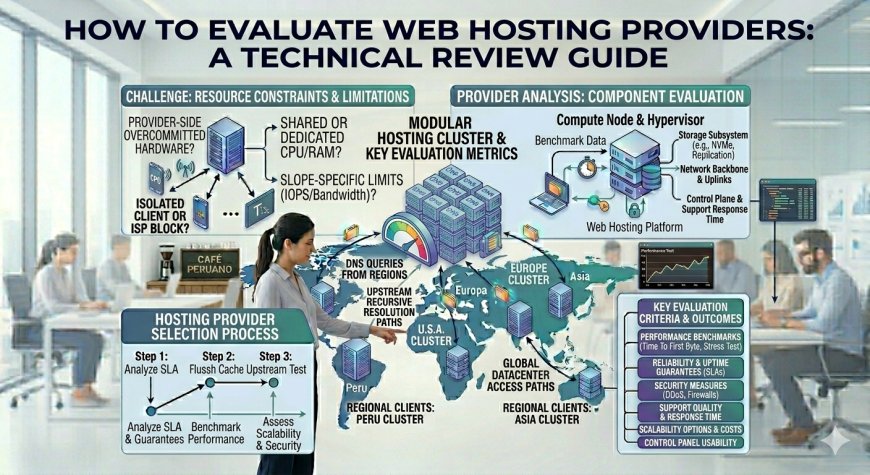
Isolating the true operational quality of a hosting service requires breaking your testing down into distinct technical pillars. You must analyze the hosting infrastructure from the outer network edge down to the core persistent disk write velocities.
A rigorous technical review workflow measures platform capabilities across three explicit layers:
-
The Network Throughput Tier: Audits global packet routing efficiency, network latency distribution across continents, and edge content delivery integration parameters.
-
The Compute Engine Tier: Measures raw processing performance under heavy execution loads, tracking multi-core efficiency, memory read/write bandwidth, and hypervisor overhead.
-
The Storage I/O Subsystem: Benchmarks input-output operations per second (IOPS), continuous sequential write operations, and random read latencies under heavy database simulations.
Quick Contrast: Marketing Reviews vs. Empirical Technical Evaluation
| Assessment Metric | Standard Affiliate Marketing Review | Empirical Technical Infrastructure Evaluation |
| Data Source | Subjective opinions and pricing sheet comparisons | Raw command-line benchmarks and stress testing |
| Performance Insight | Superficial (Mentions general uptime percentages) | Granular (Measures exact time-to-first-byte and IOPS caps) |
| Hardware Transparency | None (Accepts commercial marketing specs blindly) | High (Extracts exact CPU model data and steal-time metrics) |
| Network Verification | Restricted to localized ping test results | Global (Traces routing hops and multi-region network decay) |
| Long-Term Utility | Weak (Biased toward maximizing affiliate sales) | Strong (Secures a stable foundation for software scaling) |
How to Systematically Benchmark and Review a Host
Conducting a professional evaluation on a prospective hosting provider requires running a standardized sequence of non-destructive performance tests on a clean deployment instance.
A Critical Evaluation Rule: Never complete a hosting infrastructure review without thoroughly testing the provider's backup verification and automated disaster recovery pathways. A server configuration that boasts ultra-fast processing metrics is useless if its snapshot backup mechanisms are slow, corrupted, or lack regional redundancy. Always trigger a deliberate system wipe on a test instance to benchmark exactly how long it takes to restore your full data schema from a cold backup, ensuring your vendor meets your team's Recovery Time Objective (RTO) targets.