Shared Hosting, VPS, or Cloud: How to Choose the Right Plan in 2026
 John
John
Choosing the right type of hosting is one of the most important technical decisions when launching a website, yet it's also one of the most confusing. Providers throw around terms like "cloud," "VPS," and "shared hosting" without really explaining what they mean in practice or how they impact performance, security, and budget. In this guide, we break down the three most common hosting options in 2026, their real differences, and when each one actually makes sense.
Why the Type of Hosting Matters So Much
Hosting isn't just "the place where your website lives." It's the infrastructure that determines page load speed, uptime during traffic spikes, scalability, and — to a large degree — SEO rankings. Google penalizes slow load times and frequent downtime, which means your hosting choice ends up being a marketing decision as much as a technical one.
On top of that, each type of hosting distributes server resources differently, and that difference becomes especially noticeable as traffic grows or when you install plugins, databases, or applications that consume more CPU and memory than expected.
Shared Hosting: The Usual Starting Point
Shared hosting is the most affordable option because a single physical server hosts dozens — sometimes hundreds — of websites at the same time. All of them share CPU, RAM, and bandwidth, which keeps prices very low but also introduces what's known as the "noisy neighbor effect": if another site on the same server experiences a traffic spike or an attack, your own site can suffer in speed or availability as a result.
This type of hosting works well for:
- Personal blogs or portfolios with low to moderate traffic.
- Sites in the testing or validation phase of a business idea.
- Projects with a very tight budget that don't require high performance.
Its main limitations are the lack of control over server configuration, strict resource caps, and performance that degrades quickly as the site starts to grow. For an ecommerce store with steady traffic or an application with complex backend logic, shared hosting usually falls short.
VPS: The Middle Ground With Real Control
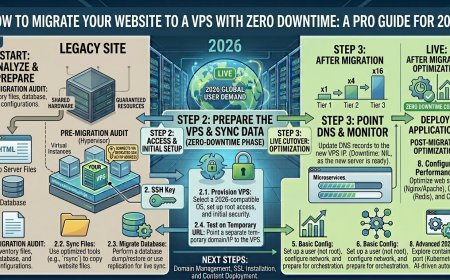
A virtual private server (VPS) splits a physical server into several independent virtual partitions, each with its own fixed allocation of CPU, RAM, and storage. Although multiple VPS instances can technically live on the same hardware, each one runs in isolation, so a neighbor's performance no longer affects yours the way it does with shared hosting.
The big advantage of VPS is control: you can choose the operating system, install custom software, configure specific firewall rules, and fine-tune the server exactly to your project's needs. There are two main flavors:
- Unmanaged VPS: you're responsible for configuration, updates, and server security. It requires solid Linux system administration knowledge.
- Managed VPS: the provider handles technical maintenance, updates, and security, letting you focus solely on your application or website.
VPS is the recommended choice for sites with medium-to-high traffic, growing online stores, custom web applications, or developers who need a specific environment (say, a particular version of PHP, Node.js, or a specific database engine). The cost is higher than shared hosting, but the jump in stability and performance usually justifies it.
Cloud Hosting: On-Demand Scalability
Cloud hosting doesn't rely on a single physical server — it runs on a network of interconnected servers that work together as one system. If one server in that network fails or gets overloaded, the load is automatically redistributed to other available nodes, which drastically reduces the risk of total downtime.
The defining feature of cloud hosting is elasticity: resources (CPU, RAM, storage) can scale up or down automatically based on real-time demand. This is especially valuable for:
- Sites with seasonal or unpredictable traffic spikes (launches, marketing campaigns, viral events).
- Applications that need high availability and fault tolerance.
- Projects scaling quickly that don't want to migrate servers every few months.
Cloud billing is typically usage-based, which can be cheaper than an oversized VPS during low-traffic periods — but it can also lead to unpredictable bills if you don't set spending limits or usage caps.
Quick Comparison
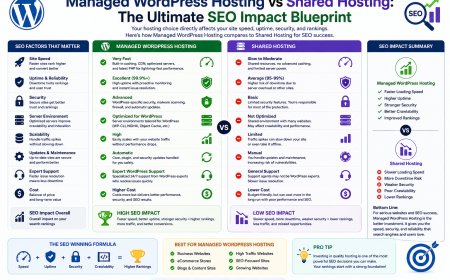
| Criteria | Shared | VPS | Cloud |
|---|---|---|---|
| Cost | Very low | Medium | Variable (pay-per-use) |
| Technical control | Limited | High | High |
| Scalability | Low | Manual | Automatic |
| Performance under high traffic | Weak | Good | Excellent |
| Learning curve | Low | Medium-high | Medium-high |
| Best for | Small sites, blogs | Growing projects | Apps with variable traffic |
Other Factors Worth Considering Before You Decide
Beyond the hosting type itself, a few other elements often make the real difference between a good provider and a bad one:
Server location. Choosing a datacenter geographically close to most of your users reduces latency and improves load times.
Backups. Check whether the provider includes automatic daily backups and how easy it is to restore your site if something goes wrong.
Technical support. For shared and managed VPS hosting, the quality and availability of support (live chat, response time, actual technical knowledge) can matter as much as the hardware itself.
Built-in security. A free SSL certificate, malware protection, a web application firewall (WAF), and intrusion monitoring should already be included by 2026 — not sold as paid add-ons.
Ease of migration. If your project is going to grow, it's worth choosing a provider that lets you scale from a shared plan to VPS or cloud without having to migrate to an entirely different company.
Conclusion
There's no single "best hosting" that works for everyone — there's only the right hosting for a project's current stage and specific needs. Shared hosting remains a reasonable starting point for small sites on a tight budget; VPS offers the ideal balance between control and cost for growing projects; and cloud hosting is the strongest bet when availability and automatic scalability are the priority. The key is to honestly assess your current traffic, expected growth, and available technical expertise before committing to a long-term plan.