The Evolution of AI Tools in 2026: From Chatbots to Autonomous Workflows
Discover how the AI tool ecosystem in 2026 is moving from basic prompts to native workflows, autonomous agents, and AI-native IDEs like Cursor.
 John
John
The Evolution of AI Tools: From Prompt Engineering to Autonomous Workflows
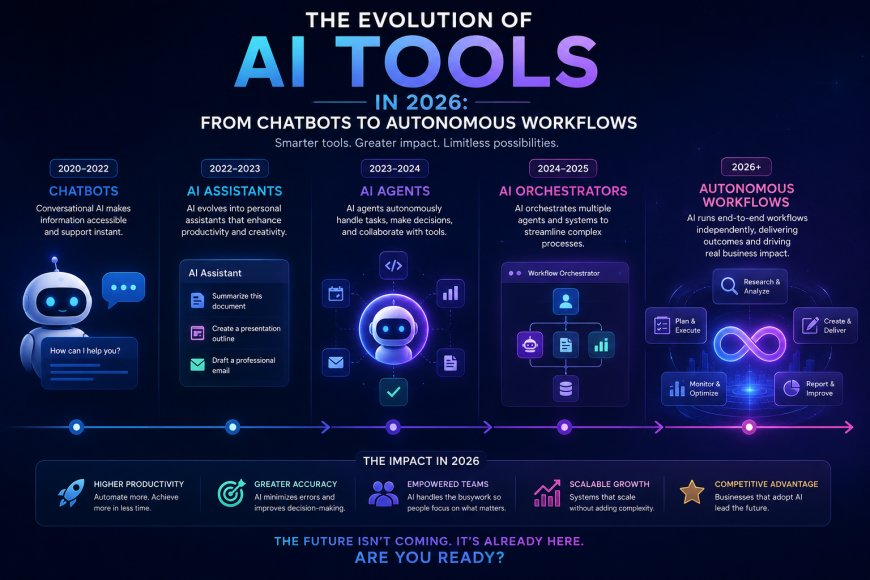
The enterprise artificial intelligence ecosystem has shifted from an experimental novelty into core infrastructure. Organizations are moving past simple chat interfaces toward deep architecture: integrated automated workflows, autonomous operational agents, and native development environments that remove the friction of manual application swapping.
In the current landscape, software efficiency is defined by deep integration rather than isolated prompts. To scale operations effectively, platforms must be evaluated by their native infrastructure and systemic compatibility.
The Enterprise AI Infrastructure Mapping
| Category | Market Leaders | Primary Enterprise Purpose |
| Language & Advanced Reasoning | ChatGPT (OpenAI), Claude (Anthropic), Gemini (Google) | Long-context documentation analysis, complex logic processing, and architectural synthesis. |
| Development & Software Engineering | Cursor, GitHub Copilot | AI-native Integrated Development Environments (IDEs) built for repository-wide code generation and debugging. |
| Automation & Autonomous Agents | Lindy, Zapier Central, Make | Building zero-code autonomous agents to manage cross-platform tasks like database synchronization and pipeline triage. |
| Interface & Web Architecture | Lovable, Framer AI, Elementor AI | Generating functional application UI, code prototypes, and system layouts from natural language inputs. |
| SEO & Content Optimization | Surfer SEO, Semrush (ContentShake), Jasper | Algorithmic search intent alignment, brand identity scale, and optimization for synthesized discovery. |
| Synthetic Asset Generation | Veo (Google), Midjourney (V6), ElevenLabs | High-fidelity cinematic rendering, deterministic image models, and enterprise-grade voice synthesis. |
Three Technical Shifts Redefining Enterprise Workflows
1. The Transition from Prompts to Autonomous Multi-Step Workflows
Legacy AI implementations relied heavily on one-off user inputs. Modern enterprise platforms like Copy.ai or Lindy utilize event-driven triggers. For instance, when a critical database entry updates, the system automatically runs a programmatic sequence: parsing unstructured documentation, checking company validation rules, generating structured logs, and updating internal management infrastructure without user intervention.
2. Zero-Friction Native Context Integration
The modern software layer builds artificial intelligence directly into the application canvas rather than requiring external browser extensions or copy-paste actions. Systems like Lovable generate complete, production-ready web codebases entirely inside their sandbox environments. Similarly, engineering tools like Cursor parse local code repositories securely to provide contextual refactoring suggestions in real time.
3. The Rise of Generative Engine Optimization (GEO)
Traditional search engine optimization frameworks are adapting to accommodate conversational answer architectures. Platforms like Search Atlas and SE Ranking now benchmark brand mentions, sentiment scores, and citation share within the outputs generated by large language models, including Perplexity and Gemini Deep Research. Adapting your digital content to these model citation systems is now a core visibility requirement.
Strategic Implementation Verdict
When designing an internal tooling roadmap, selecting isolated tools based on a low price index is a critical error. True ROI comes from native environment integration. Platforms that support secure API pipelines, advanced context windows, and high data security standards should form your primary software stack. Focus on building seamless automated workflows rather than deploying disconnected chat interfaces.